
IMARA
Imitiation MAchine for Robotic Assistance: Artificial Intelligence and Collaborative Robotics Supporting Operating Room Teams
€ 478 367,40
from European funds
For a total budget of € 956 734,80
Last updated on April 17, 2026
Project leader:
Institut Hospitalo-Universitaire de Strasbourg
Project partners:
- Hochschule Reutlingen
- Fraunhofer-Gesellschaft zur Förderung der angewandten Forschung e. V.
- Université de Strasbourg
- Bosch Health Campus GmbH
- Centre de Formation des Professions Paramédicales des Hôpitaux Civils de Colmar
- Ministerium für Wissenschaft,
Forschung und Kunst Baden-Württemberg - Région Grand Est
- Ministerium für Wissenschaft und Gesundheit Rheinland-Pfalz
The IMARA (Imitation MAchine for Robotic Assistance) project is an ambitious Franco-German research initiative aimed at transforming the operating room environment through the introduction of collaborative robotics. Supported by the Interreg Upper Rhine program, this project is part of a cross-border innovation effort designed to address the major challenges of modern healthcare.
The Challenge: Reducing the Workload on Nursing Teams
Operating rooms are critical hubs where cutting-edge expertise is concentrated under intense pressure. At the heart of this system, nursing teams (IBODE) must not only assist surgeons but also manage numerous time-consuming logistical tasks, such as preparing carts, checking equipment, and transporting supplies.
Against the backdrop of a growing shortage of healthcare staff in Europe, these safety-critical tasks reduce professionals’ availability for their core mission: patient care. The IMARA project was designed specifically to address this challenge by automating these logistical operations, thereby lightening the mental and physical workload of teams while reducing the risk of human error.
A Robotic Platform with Dual Innovations
IMARA is based on the development of a mobile, intelligent robotic platform built on two complementary technological components:
- An autonomous mobile robot: Designed to safely transport surgical supplies from storage areas to the heart of the operating room.
- A robotic arm equipped with imitation learning: Using computer vision and artificial intelligence, this arm observes and replicates nurses’ gestures for preparing and presenting instruments.
Unlike traditional surgeon-controlled surgical robots, this system is designed to anticipate needs and interact seamlessly within the hospital’s digital environment. These technologies, derived from industry and ingeniously adapted for the medical field, are part of an interoperable ecosystem designed for seamless integration into hospital workflows.
Disruptive Technology: Imitation Learning
At the heart of IMARA’s innovation lies Imitation Learning. The system does not follow rigid programming but uses Machine Learning algorithms to acquire skills by observing clinical experts. Through repetition and analysis of movements, the robot learns to identify the necessary instruments at the right moment, in a natural and intuitive way.
A Consortium of Excellence and Co-Design
A co-design approach is at the heart of the project: prototypes are developed and tested directly with clinical teams to ensure they meet real-world needs. This success is based on synergy between French and German partners:
- Scientific and technological expertise: IHU Strasbourg (project leader), the University of Reutlingen (NXT Center), the ICube laboratory (IRIS) in Strasbourg, and the Fraunhofer IPA Institute in Mannheim.
- Hospital expertise and training: The Operating Room Nursing Training Institute (IFIBO) at the Colmar Civil Hospitals and the Bosch Health Campus in Stuttgart.
Support and Funding
The IMARA project is co-financed by the European Union through the European Regional Development Fund (FEDER) as part of the Interreg Upper Rhine program. This financial support underscores the strategic importance of cross-border cooperation for technological sovereignty in healthcare and research excellence in the Upper Rhine region.
IMARA is a project of the Science Initiative of the Tri-national Upper Rhine Metropolitan Region with a total budget of €956,734, including €478,367 in funding from the European Regional Development Fund (FEDER) and the Interreg Upper Rhine program, and €239,183 from the Grand Est Region, the state of Baden-Württemberg, and the state of Rheinland-Patz.
IMARA is a project of the Science Initiative of the Tri-national Upper Rhine Metropolitan Region, with a total budget of €956,734, including €478,367 in funding from the European Regional Development Fund (FEDER) and the Interreg Upper Rhine program, and €239,183 from the Grand Est Region, the Ministerium für Wissenschaft, Forschung und Kunst of Baden-Württemberg, and the Ministerium für Wissenschaft und Gesundheit of Rhineland-Palatinate.

Progress Report
Officially launched in March 2026, the IMARA project is making steady and ambitious progress through its initial phases.
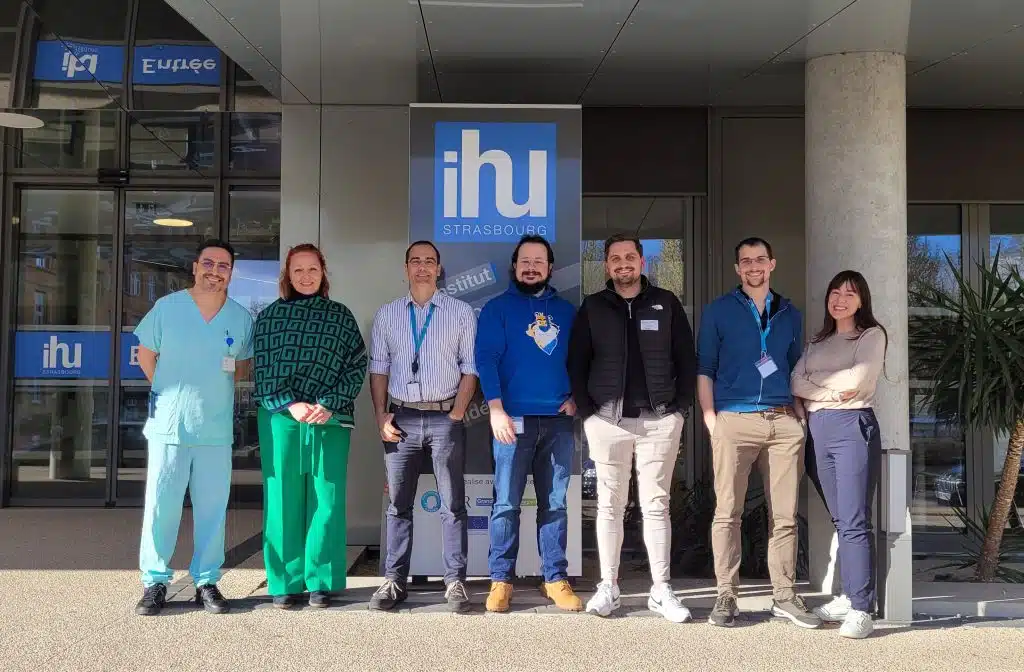
- State of the art and mapping: A thorough review of the current state of medical and scientific knowledge has enabled us to map existing solutions and challenges in the field of robotic assistance in the operating room. This solid foundation now guides future developments.
- Medical co-design workshop: The team is preparing a series of Franco-German workshops and surveys conducted directly with operating room professionals. The goal is to precisely identify the logistical tasks best suited for automation and to formalize the actual clinical need.
- Technological Developments: Initial exploratory work has begun on imitative learning robotic platforms and on optimizing the mobile transport robot. Additionally, for the mobile robot, Reutlingen University is working on detecting objects close to the ground to enable obstacle avoidance and navigation. On the Icube (IRIS) side, several projects are underway regarding the platform’s configuration (robot motors, accessories, grippers adapted for handling surgical instruments) and the identification of AI models for imitation learning. These milestones pave the way for increasingly sophisticated prototypes, designed in close collaboration with healthcare teams.
Learn more about the project:
- Official Interreg Upper Rhine – IMARA website
- Technical details on the University of Reutlingen website
- Project news on the IHU Strasbourg website
Project contacts: